
Hell in a Shell:
Corruption In Privatized Crisis Management

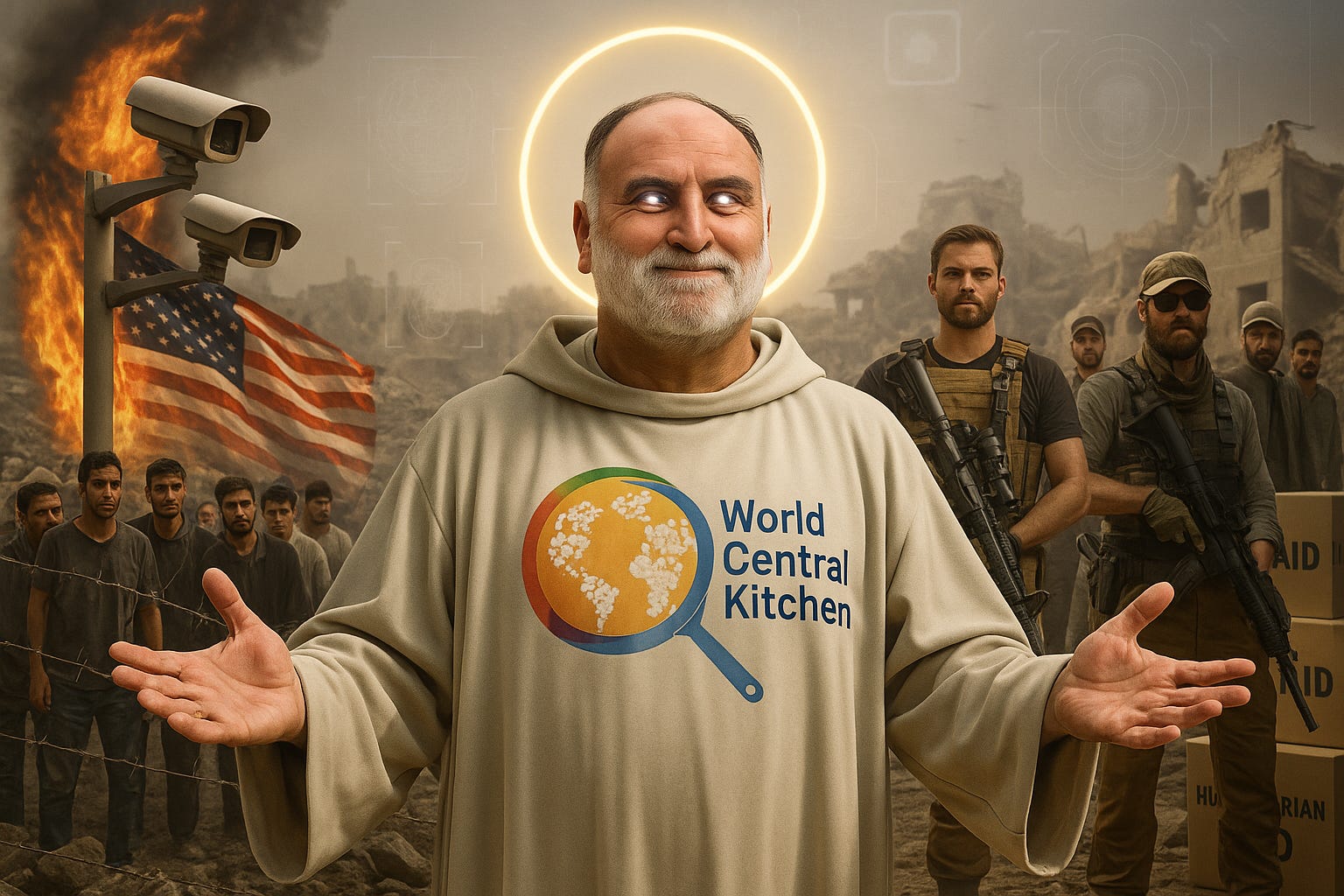
The Gaza Humanitarian Foundation (GHF) was introduced earlier this week as the centrepiece of a new international relief effort—an operation ostensibly designed to stabilize a region on the brink of collapse. But almost immediately, it was branded a disaster. Media outlets rushed to portray the launch as a chaotic, poorly executed mission led by amateurs overwhelmed by the complexity of warzone logistics.


The Footage from the scene globally reinforced that image: civilians milling aimlessly in flattened, featureless fields under visible Israeli military supervision; aid boxes stamped with fresh GHF logos haphazardly dumped into the sand; no tents, no storage units, no distribution points—just open space and the illusion of effort. There was no infrastructure to speak of. No sign of coordination. No visible presence of the high-level security, logistics, or medical professionals, the foundation claimed, was behind the rollout. The entire scene looked less like a humanitarian operation and more like a set—an elaborate photo opportunity staged to showcase dysfunction.
Reports from the Associated Press and Al Jazeera described the launch as disorganized and dangerous. UN agencies issued statements flagging safety concerns.
But, several visuals from the launch raised immediate red flags. Some featured oddly repetitive facial features, uniform lighting across disparate subjects, and compression artifacts that hinted at digital tampering- they also dont really make any sense. In certain frames, the unnatural depth and context suggest AI manipulation, though this has not been conclusively verified. Not to suggest the situation isn’t dire, but it’s important to recognize that fabrications may be involved—and the motive isn’t always to raise genuine awareness for the people. Overall, the effect feels less like documentary realism and more like manufactured chaos.


These were experts.
Why are they piling aid in the middle of what looks like the new IDF military bases?
The GHF’s internal memo listed high-level personnel with extensive careers in crisis response and military logistics. Lt. Gen. Mark Schwartz, who served as the U.S. Security Coordinator for Israel and the Palestinian Authority, was included.


So was Bill Miller, a former UN security operations chief. These men have overseen field stabilization and counterinsurgency planning across multiple conflict zones. Standard procedures in those environments include biometric registration, hardened supply lanes, cold-chain medical storage, and secured civilian intake points.
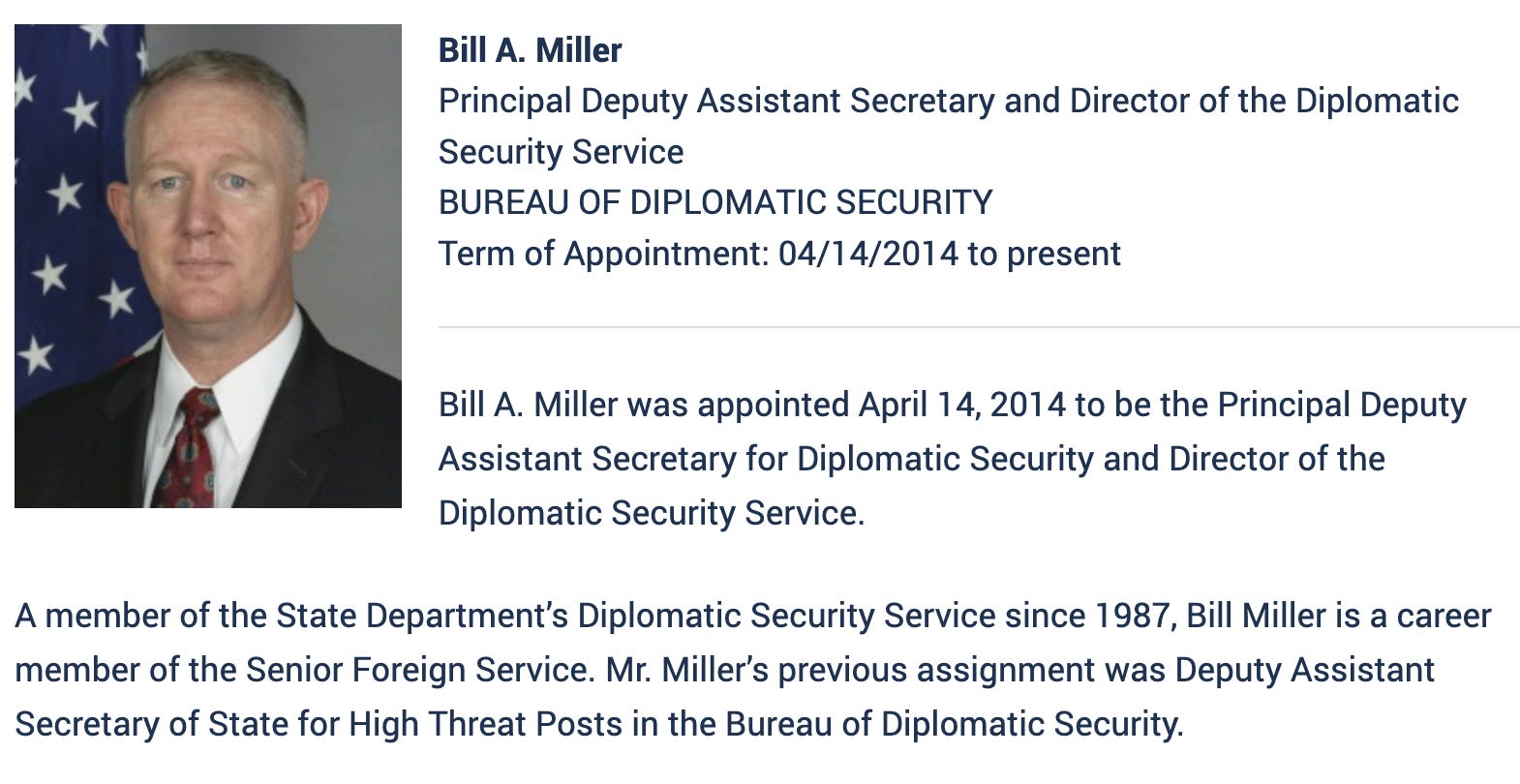
None of those components were visible in the GHF launch.


This was supposed to be a high-level, precision-guided humanitarian operation—backed by seasoned professionals with careers in military logistics, State Department crisis planning, and post-conflict stabilization. But none of that expertise showed up. Not in the planning. Not in the execution. And certainly not in the aftermath.
There were dudes literally throwing up Shaka.
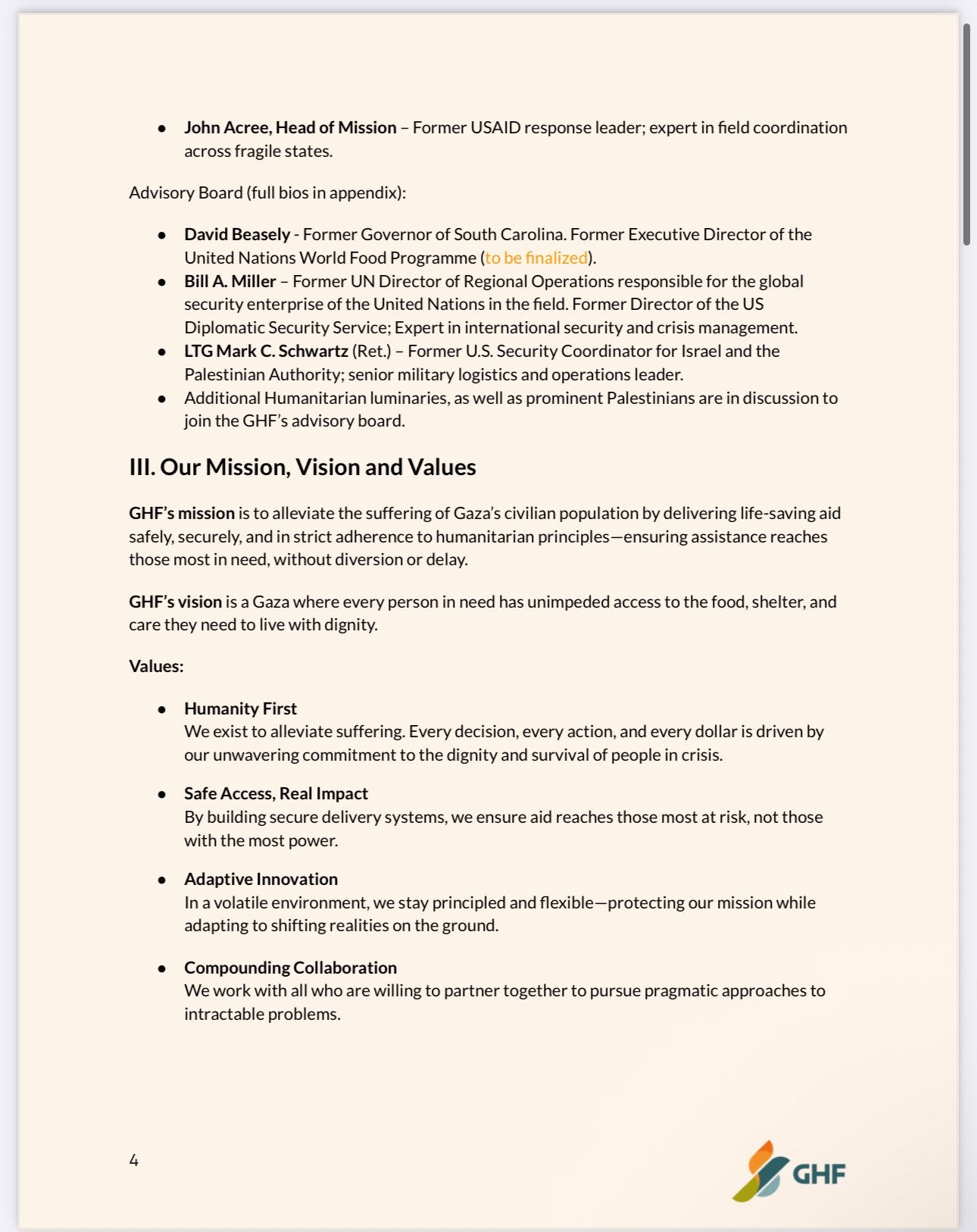
If these individuals were truly steering the rollout, it wouldn’t have unfolded like a disoriented flash mob in a sand pit. And yet their names were used to frame the initiative as credible. Their credentials gave the project its institutional posture. They were publicly listed. Positioned as key figures. But when contacted for comment, several flatly denied any involvement. Not vague distancing. Not carefully worded PR statements. Direct disavowals. But also not all that mad either..


Who assembles a memo packed with national security veterans and international logistics advisors—only for none of them to appear, take responsibility, or even acknowledge the launch? That doesn’t sound like bureaucratic oversight, it sounds like it was deliberate.
I mean, veteran golden boy Jake Wood resigned the night before the launch, out of some moral dilemma? That’s the story we’re sold. After a career as a Marine sniper and head of Team Rubicon—with over a thousand deployments, many of them in active war zones—he finally drew the line at a food drop. Really? This guy has worked in every disaster theatre on the map, most of them with military coordination, intelligence cover, and private sector donors. But now, suddenly, he finds Jesus. Overnight. Just in time for the headlines.
David Burke, his deputy, also walked. Former Marine logistics officer, trained in field coordination under combat conditions. Same timing, same exit. They both had a change of heart in perfect sync—twelve hours before the rollout, after months of planning, meetings, and funding. They missed all the red flags until the very last minute?


These aren’t Boy Scouts. They don’t get “surprised” by operational collapse. They don’t resign on conscience. They resigned on schedule. Because the plan wasn’t to fix anything, by stepping out just in time, they avoided accountability for a collapse they saw coming, if not helped script. And their departure made way for World Central Kitchen to move in—an organization with overlapping personnel, funders, and operational philosophy with its eye on Gaza.
World Central Kitchen.
The REAL Gaza Humanitarian Foundation.
There’s much more happening in Gaza than just food drops and humanitarian spin—it’s about gas, trade infrastricture development, land, and the struggle for long-term control.A network of elite, tactically trained billionaires, ex-intel operatives, and state-linked NGOs is positioning itself to carve up Gaza’s future. They don’t run fake NGOs like the Gaza Humanitarian Foundation just to fail—they run them to create tax vehicles, media pivots, and controlled collapses that justify installing their own systems. The fallout opens space for privatized logistics (Fogbow), mercenary enforcement (Safe Reach, UG Solutions), financial laundering The Maritime Humanitarian Aid Foundation and polished optics (José Andrés). The real goal is to erase UNRWA, erase sovereignty, and manage Gaza through biometric aid checkpoints and donor-locked relief corridors. Everybody wants a piece of Gaza’s future—its gas, its reconstruction cash, its containment model—and they will burn whatever’s left to get it.
Image Matters
WCK had already developed a shit presence in Gaza before GHF’s orchestrated collapse. In October 2023, WCK volunteers provided meals to Israeli soldiers, which concretized their image.


In April 2024, an Israeli “drone strike” allegedly killed seven of its workers. The response to the strike was immediate and widespread. Footage of the aftermath circulated on major outlets. President Biden even called José Andrés personally. Coverage from the New York Times and CNN framed WCK as an innocent casualty of the war. It was weird. A lot of the claims about the strikes were exaggerated—and logistically incoherent. But they served a purpose.
They allowed the organization to position itself as just another casualty of Israeli aggression. One more victim, indistinguishable from the rest of the suffering Palestinian population. Convenient. Because without that framing, they’d have to explain what they actually are: an Israeli-American intelligence asset posing as a relief NGO, ready to step in wherever real institutions are being dismantled. And they’d rather be pitied than identified.


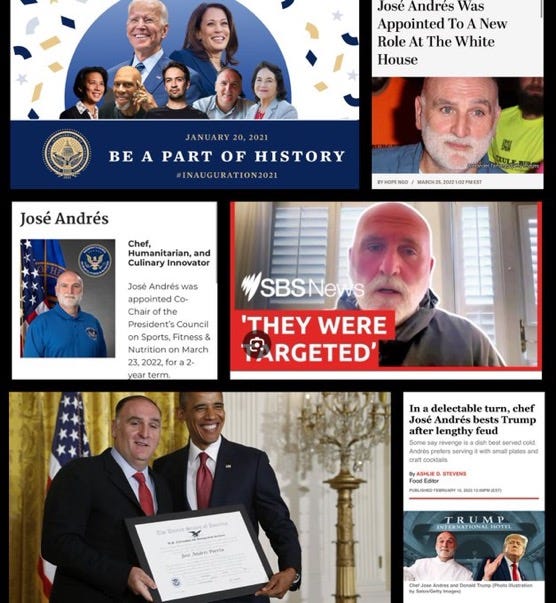
And José Andrés is not just some rando chef or nonprofit founder who wants to help people. He’s a billionaire who’s served on President Biden’s transition team, and previously advised the Obama White House. His years-long legal battle with Donald Trump is well documented be it real or fabricated.


Funnily enough, Andrés has publicly criticized the GHF collapse—calling it a failure of vision and execution.


But what he hasn’t acknowledged is that his own network, along with COGAT helped shape it.


He has reposted content from DropSite News, the same outlet that released the internal GHF memo. Imagine that..
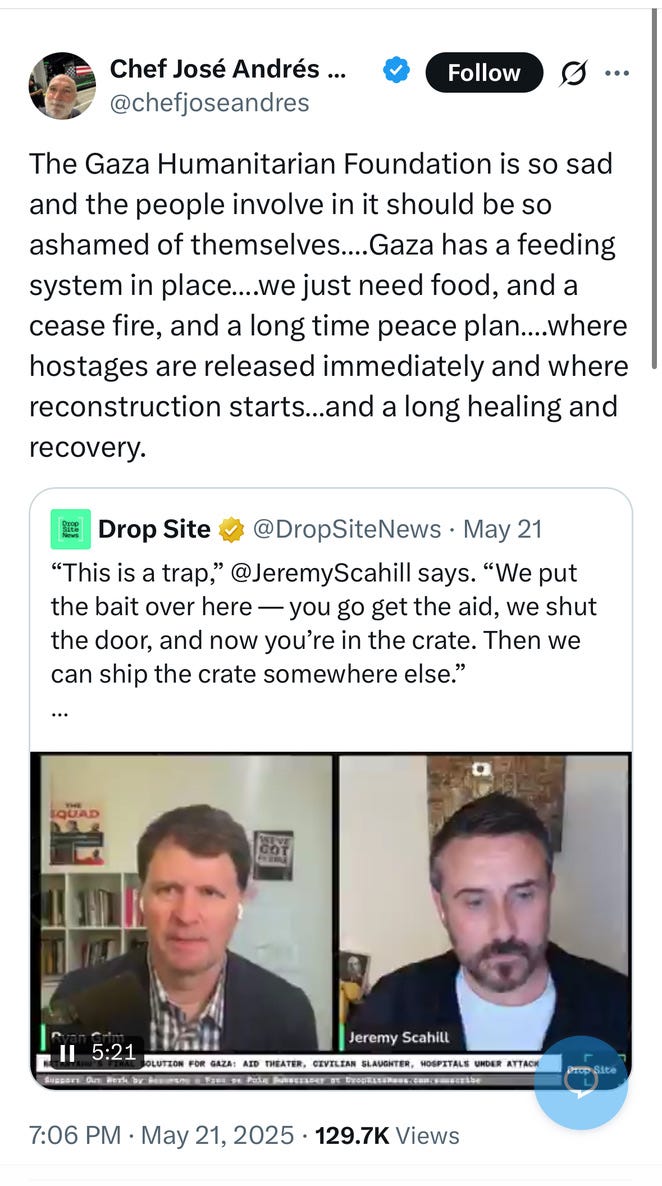
WCK was built for this role. On paper, it presents as an emergency food relief nonprofit, deploying after disasters, conflicts, and famines. But in practice, it operates as a soft-power instrument, working alongside U.S. military frameworks, intelligence-linked philanthropies, and private logistics contractors. Its key partners include the Howard G. Buffett Foundation, known for biometric surveillance programs and border militarization, not humanitarianism. WCK doesn’t just bring meals—it brings optics, narrative control, and pre-cleared corridors for strategic influence. It also offers elite donors tax relief, reputational cover, and access to unstable regions under the legal umbrella of charity.


The Gaza Humanitarian Foundation was —a shell, or at least that’s how it will be utilized - an NGO filled with real names of people too rich to really give a shit, fake leadership, and a memo that read more like a military blueprint than a relief strategy. When it collapses fully, WCK will emerge as the pre-installed replacement: clean, camera-ready, and already vetted by the media infrastructure that helped script the transition.
WCK’s rise has followed a clear political trajectory, backed by corporate donors and diplomatic channels.
WCK’s key backers include:
➤ Jeff Bezos (Bezos Earth Fund)
➤ Howard G. Buffett Foundation
➤ Open Society–aligned grant networks
➤ Corporations like Amazon, PepsiCo, and Airbnb
These aren’t humanitarian entities. These are just a few wealth engines with geopolitical interests, they’re part of a system where humanitarianism becomes a delivery mechanism for surveillance, dependency, and enforced political order.


This is what the transition looks like. A WCK staffer stands smiling in front of a branded aid ship. Hours later, the Israeli military posts a video calling their work “critical.” The same military that bombed schools and hospitals is now endorsing the group delivering food to the people they displaced.
This isn’t just a logistical shift. It’s the erasure of Palestinian-led aid, replaced by foreign-run operations that don’t answer to the communities they serve. UNRWA built schools, hired locals, kept records of families. WCK brings in food drops and PR campaigns. One was rooted. The other was installed.
What Anthony Blinken wanted was never about improving relief. It was about removing anything that couldn’t be controlled. What’s left is a system that claims to feed people—but works in step with those who starve them.
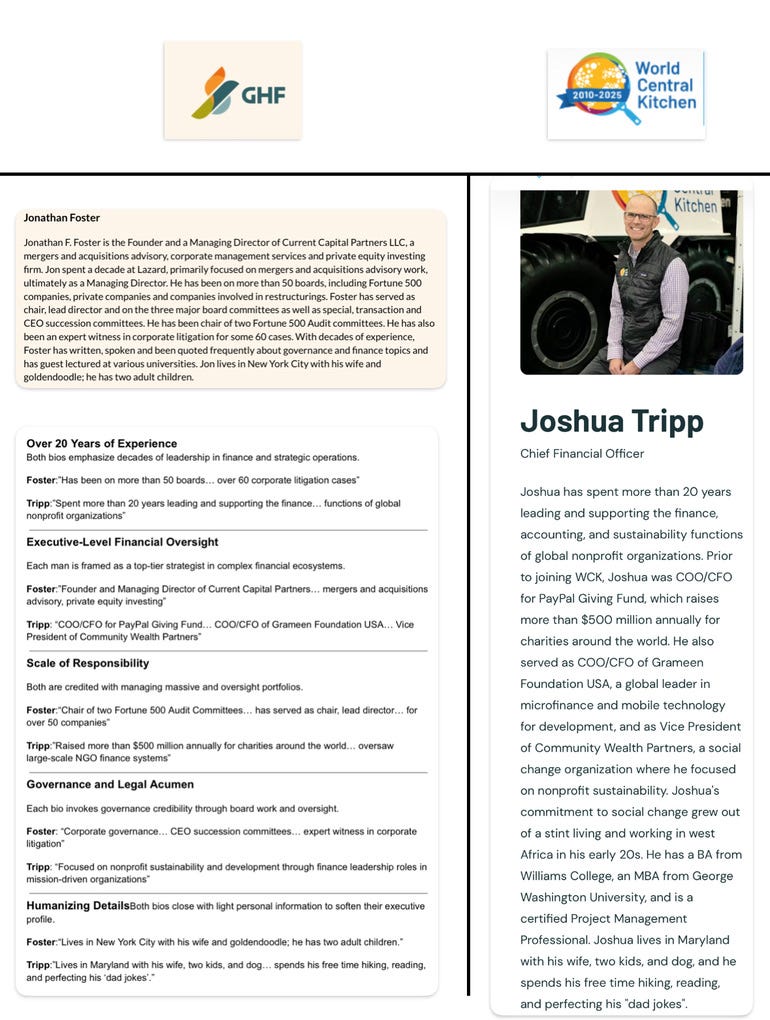
This is just one example of a shell operation that happened to get exposed—but even that serves a purpose. Its failure becomes the justification for installing something “better,” something more professional, more polished. And when people say war is business, they usually mean weapons. But it’s so much bigger than that. This is business built on disaster—fueled by manipulation, exploitation, orchestrated logistics, media collusion, and contracts designed for profit and tax evasion.
The people come last.
great work.
He is a snake.
One connection that might lead you places you haven’t been yet is his work with the Clintons on the Clean Cookstoves initiative. I forget the details but I do recall that it was a bigger story than it originally seemed.